Program evaluation questions, with examples participants answer at the last session
Program evaluation questions come in two kinds: the few big questions an evaluation sets out to answer (did the program work, for whom, and was it run as planned) and the survey questions participants answer to give you the evidence. These 35 are the second kind, each linked to the big question it helps answer.
- 35questions
- 12in the core set
- 4 minto answer the core
- 2 roundsend and follow-up
By Michael Hodge, BSc Psychology Updated September 2026
Simple evaluation questions for the final minute of a session
Only have a minute at the end of a session? These five ask whether the program kept its promise, whether it was useful, whether people can apply it, whether it was worth their time and what to change.
- 01The program delivered what it promised when I signed up.
- 02What I learned is useful in my work or daily life.
- 03I feel able to use what I learned without help.
- 04The time I gave to this program was worth it.
- 05What should we change before the next group starts?
Program evaluation question examples, grouped by set
The core 12 is already ticked. Add a set for delivery, reach, then-and-now ratings or the follow-up, or tick single questions. Each item lists its answer choices and what a high or low result means, ready to copy, print or open in the builder.
The core 12: end of the program12 questions
Give these in the final session. Eight statements cover the promise, relevance, delivery, learning and value, then attendance, a 0 to 10 recommendation and two open questions.
-
The program delivered what it promised when I signed up.
Strongly disagree12345Strongly agree1 = Strongly disagree, 5 = Strongly agreeChecks the program against its own stated aims, which is where every evaluation starts.
-
What I learned is useful in my work or daily life.
Strongly disagree12345Strongly agree1 = Strongly disagree, 5 = Strongly agreeRelevance predicts whether people go on to use what they learned better than enjoyment does.4
-
The program was well organised from start to finish.
Strongly disagree12345Strongly agree1 = Strongly disagree, 5 = Strongly agreeA process measure. Low scores point to scheduling, communication or venue problems you can fix quickly.
-
The facilitators explained things clearly.
Strongly disagree12345Strongly agree1 = Strongly disagree, 5 = Strongly agreeRates delivery on one thing participants can judge, instead of asking them to grade expertise.
-
I had enough chances to practise or ask questions.
Strongly disagree12345Strongly agree1 = Strongly disagree, 5 = Strongly agreeShows whether the program left room for doing, not only listening.
-
I feel able to use what I learned without help.
Strongly disagree12345Strongly agree1 = Strongly disagree, 5 = Strongly agreeConfidence at the end is an early sign of whether people will apply the learning later.4
-
I plan to use something from the program in the next month.
Strongly disagree12345Strongly agree1 = Strongly disagree, 5 = Strongly agreeCommitment. Read it next to the follow-up set to see how many plans turned into action.4
-
The time I gave to this program was worth it.
Strongly disagree12345Strongly agree1 = Strongly disagree, 5 = Strongly agreeThe participant side of value for money. Put it beside your cost figures for the efficiency question.
-
How much of the program did you attend?
All of itMost of itAbout halfUnder halfDose. Compare answers by attendance before judging outcomes, since people who missed half got a different program.
-
How likely are you to recommend this program to someone in your situation?
0123456789100 = Not at all likely, 10 = Extremely likelyOne 0 to 10 number you can track from one group to the next and quote in a report.
-
What was the most valuable part of the program for you?
Open answerTells you what to protect when the program changes. The answers also supply quotes for funders.
-
What should we change before the next group starts?
Open answerAsks for a fix, not a verdict. Sort the answers into themes and act on the biggest one.
Delivery and experience7 questions
Add these when you are checking how the program ran: length, level, materials, format and the feel of the group.
-
The length of the program was:
Too shortA bit shortAbout rightA bit longToo longSays which way to adjust. An average hides it, so look at how answers split.
-
The level of the content was:
Too basicA bit basicAbout rightA bit advancedToo advancedMixed answers mean a mixed group. That points to streams or pre-reading, not a rewrite.
-
How would you rate the handouts and slides?
Very poor12345Excellent1 = Very poor, 5 = ExcellentMaterials are the part of a program people keep. Low ratings are cheap to fix.
-
The time, place or format made it easy to take part.
Strongly disagree12345Strongly agree1 = Strongly disagree, 5 = Strongly agreeLogistics decide who can attend at all. Read it with the attendance question in the core.
-
I felt comfortable sharing my ideas in the group.
Strongly disagree12345Strongly agree1 = Strongly disagree, 5 = Strongly agreeGroup safety. People who hold back learn less from each other and say less in the open answers.
-
Program staff answered my questions quickly.
Strongly disagree12345Strongly agree1 = Strongly disagree, 5 = Strongly agreeSupport between sessions, which participants notice as much as the sessions themselves.
-
Which topic did you expect but not get?
Open answerA short list of gaps, straight from the people the program is for.
Reach and access3 questions
For funders and program managers asking whether the program reaches the people it was designed for.
-
How did you first hear about the program?
Friend or familyEmployer or schoolAnother serviceSocial mediaFlyer or posterShows which channels bring people in, so outreach money goes where it works.
-
What was your main reason for joining?
To learn a skillFor my jobSomeone referred meTo meet peopleSomething elseMotives explain outcomes. People sent by a referrer often want different things from volunteers.
-
What nearly stopped you from taking part?
CostTimeTravelCaring dutiesUnsure it was for meNothingTick all that applyThe barriers list. Remove the top one and the next group is bigger and more varied.
Then and now (before-and-after in one sitting)4 questions
Two pairs asked at the end: people rate where they started and where they are now. Swap "the skills it covers" for your program's own skill, such as budgeting or first aid.
-
Thinking back to before the program, how confident were you in the skills it covers?
Not at all confident12345Extremely confident1 = Not at all confident, 5 = Extremely confidentThe "then" rating, given after people know what the skill really involves.5
-
Today, how confident are you in the skills the program covers?
Not at all confident12345Extremely confident1 = Not at all confident, 5 = Extremely confidentThe "now" rating. The gap between the pair is each person's self-reported change.5
-
Thinking back to before the program, how much did you know about its topic?
Very littleA littleSomeA lotA great dealKnowledge, rated from where people stand now, so both answers use the same yardstick.
-
How much do you know about the topic today?
Very littleA littleSomeA lotA great dealPair it with the previous question to count how many people moved up at least one step.
Follow-up, a few weeks later6 questions
Send these as a second short survey once people have had time to use what they learned. This is where outcomes show up.
-
Since the program ended, how often have you used what you learned?
Not yetOnce or twiceAbout weeklySeveral times a weekEvery dayBehaviour, the step between learning and results. Compare it with the plan-to-use statement from the core.4
-
What has changed for you since the program?
I do a task differentlyI feel more confidentI taught someone elseI reached a goalI made useful contactsNothing yetTick all that applyA quick count of outcomes that participants themselves recognise.
-
The program has made a real difference to my work or life.
Strongly disagree12345Strongly agree1 = Strongly disagree, 5 = Strongly agreeThe outcome question in one line. Report it alongside the concrete examples below.
-
What has made it hard to use what you learned?
No timeNo chance to use itNo support around meForgot parts of itNothing hasTick all that applySeparates a program problem from a workplace or home problem. Only the first is fixed by changing the program.
-
What would help you keep using what you learned?
A refresher sessionNotes or videosA mentor or buddyA peer groupNothing moreTells you which follow-up support to offer, and whether people want any.
-
Describe one thing you now do differently because of the program.
Open answerStories of change. The best ones make the evaluation report readable and show funders what happened.
About you (optional)3 questions
Useful for comparing online and in-person participants, or age groups. Publish a split only when every slice is big enough to hide any one person.
-
What is your age group?
Under 1818 to 2425 to 4445 to 6465 or olderAnswers the "for whom" part of the evaluation: did the program work as well for every age group?
-
How did you take part?
In personOnlineA mix of bothLets you compare formats before deciding where to run the next round.
-
Have you taken part in one of our programs before?
No, this is my firstYes, once beforeYes, several timesReturning participants often rate differently. Keep them apart when you compare groups.
Key evaluation questions and the survey items that answer them
Evaluators separate the two on purpose. Key evaluation questions "are the high-level questions that an evaluation is designed to answer - not specific questions that are asked in an interview or a questionnaire."1 Pick your key questions first, then send the survey items that feed them.
| Key evaluation question | Type | Items on this page |
|---|---|---|
| Is the program reaching the people it was built for? | Process | Reach and access, About you |
| Is it being run as planned, and run well? | Process | Core 3 to 5, Delivery |
| How satisfied are participants, and which ones? | Process | Core 1, 8 and 10, split by About you |
| Did people gain the knowledge and skills intended? | Outcome | Core 6 and 7, Then and now |
| Are people using it, and what changed? | Outcome | Follow-up |
| Was it worth the time and money? | Efficiency | Core 8, plus your cost records |
Keep the big questions few
BetterEvaluation advises a maximum of five to seven main questions, with more specific questions sitting under each one.1 The CDC sorts them the same way: process questions about how the program is delivered (inputs, activities, outputs), and outcome questions about its short, intermediate and long-term effects.2
Keep a question only if someone will act on the answer
The CDC checklist ranks candidate questions by whether they reflect the program's goals, will give information that can be acted on to make improvements, and can be answered with the budget and staff you have.2 A survey item that answers none of your key questions can go.
One question this survey cannot answer
"Does the program address a real need?" is asked before a program starts. Use the needs assessment survey questions for a service or organisation, or the community needs assessment for a neighbourhood or town.
From first plan to shared results
Four steps turn a feedback form into evidence a manager or funder can use. They follow the order evaluators work in: questions first, then data, then action.
Agree the big questions with the people who need the answers
Before writing a single survey item, sit down with staff, funders and a few participants. The CDC's 2024 evaluation framework puts it as a step of its own: engage collaboratively with interest holders "to identify and prioritize the questions that they would like the evaluation to answer."3 The table above shows which survey items answer each common key question.

Collect the core 12 before people leave the last session
Set aside ten minutes at the start of the final session, not the end, when half the room has a train to catch. Put the survey link on screen for phones, or hand out the printed questionnaire and collect it in a tray by the door. The then-and-now set fits in the same sitting.

Send the follow-up while there is still time to help
Whether people use what they learned only shows once they are back at work or home. Kirkpatrick Partners warns that measuring this "cannot begin at 90 days after learning", because by then the chance to adjust has passed.4 A few weeks after the last session, send the six follow-up questions as a separate short survey, and offer the support people ask for.

Show participants what their answers changed
Acting on findings is the last step of the CDC framework, and the one participants see.3 Post the results, name one or two changes the next group will get, and tell funders what the stories in the follow-up show. When participants can point to a change they asked for, the next evaluation gets more replies.
Want a read on the room mid-program, with time left to change course? Kirkpatrick Partners recommends pulse checks during a program, not only a survey at the end.4 Ask one of these as a live poll participants answer on their phones. Our poll how-to covers links, QR codes and screens.
Measure change without a pretest
Forgot to survey people on day one? The then-and-now set gives you a before-and-after comparison from a single survey at the end.
How it works
At the end of the program, each person rates the same skill twice: where they think they were before the program, and where they are today. Evaluators call this a retrospective pretest. Both ratings come from someone who now understands what the skill involves, so they use the same yardstick.
Why it can beat a day-one survey
On day one, people often rate themselves higher than they later realise they were, because they do not yet know what they do not know. A study of 307 mothers in a home-visiting program found that when this shift happened, the usual pretest and posttest comparison underestimated the program's effects, while the then-and-now method gave a truer reading and was simple and quick to run.5
Reading the pairs
| Answer pattern | What it means | What to report |
|---|---|---|
| Now is higher than then | The person reports growth | Share who moved up one step or more |
| Now equals then | No change reported | Check attendance and the level question |
| Then is already high | Little room to grow | Consider a more advanced stream |
Report the share of people whose "now" rating is at least one step above their "then" rating, next to one or two stories from the follow-up. For a single session rather than a whole program, the training feedback poll questions are quicker.
See which part of the program to fix first
Enter how many participants picked each number for the eight core statements. On all eight, agreement is the result you want, which makes the lowest bar your first job before the next group arrives.
- 1Take the number of people at each point from the online results or the paper forms. Choices 4 and 5 become the percent agreeing on the chart.
- 2Low on usefulness or on feeling able to use it? Change the content. Low on organisation or clear facilitators? Change the delivery.
- 3Split the results by attendance before you draw conclusions. Someone who came to half the sessions took part in a different program.
- 4Put the two open questions next to the lowest bar. They usually say why it is low and what to do about it.
End-of-program results
A form for the community hall or the last session
Paper works best in a final session, a community hall or anywhere phones are not a given. Both PDFs print on US letter or A4.
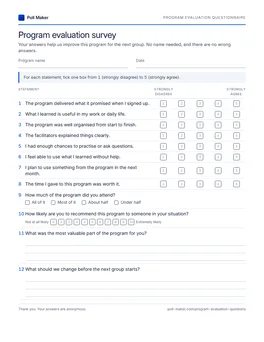
Program evaluation questionnaire
Page one holds the end-of-program dozen, with a line for the program name; after it come the delivery, reach, then-and-now, follow-up and About you sets. Skip any set you are not using.
Download PDF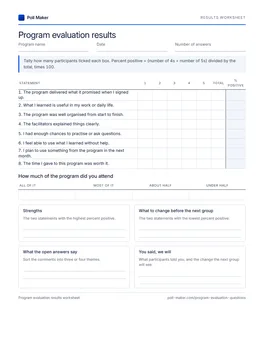
Results worksheet
Count attendance and the eight core statements by hand, find the percent agreeing for each, and mark the change the next group should see.
Download PDFProgram evaluation questions, answered
For program managers, nonprofit staff and students of evaluation.
What is a program evaluation question?
It can mean two things. A key evaluation question is one of the few big questions an evaluation exists to answer, such as "did participants gain the skills intended?". A survey question is what participants actually answer to give you evidence for it. Good evaluations start with the first kind and use the second kind to answer them.
What is the difference between process and outcome evaluation questions?
Process questions ask how the program was delivered: who it reached, whether it ran as planned and how participants found it. Outcome questions ask what changed as a result: knowledge, skills, behaviour and results. The CDC recommends sorting every question into one of the two.
How many questions should a program evaluation survey have?
Around 12 at the end of a program, which takes about four minutes, plus five or six in a follow-up a few weeks later. Behind them, keep your key evaluation questions to five to seven.
When should you send a program evaluation survey?
Twice. Give the core 12 during the final session, when everyone is in the room, and send the follow-up set a few weeks later, once people have had a chance to use what they learned.
Can I measure change if I did not survey people at the start?
Yes. Use the then-and-now set: at the end, each person rates where they were before the program and where they are now. Count the people whose second rating is higher.
Evaluation questions that mislead, reworded
Each weak version below turns up on real program surveys. For more fixes across every question type, see writing better survey questions.
Did you like the program?
What I learned is useful in my work or daily life.
Liking a program and getting something from it are different. Usefulness is the one that predicts people applying it.
Were the facilitators knowledgeable and engaging?
The facilitators explained things clearly.
Two qualities in one question, and participants cannot judge expertise. Clear explanations they can judge.
How much did the program improve your skills and confidence?
Thinking back to before the program, how confident were you in the skills it covers?
Today, how confident are you in the skills the program covers?
The weak version assumes an improvement and asks about two things. The pair lets each person show their own change.
Would you recommend this program? (Yes / No / Maybe)
How likely are you to recommend this program to someone in your situation? (0 to 10)
Three options lump the lukewarm with the keen. An 11-point scale shows the difference and can be tracked over time.
Evaluate your program this week
Load the core 12, rename it for your program and put the link on screen in your final session, or print the questionnaire and bring a pencil for every chair.