Internal customer satisfaction survey questions for IT, HR, finance and facilities
An internal customer satisfaction survey asks colleagues how well a support team such as IT, HR, finance or facilities serves them. Twelve core questions cover reach, speed, first-time fixes, updates and know-how; five more go out after each closed ticket.
- 36questions
- 12in the core set
- 4 minto answer the core
- 5for each closed ticket
By Michael Hodge, BSc Psychology Updated September 2026
All 36 internal customer satisfaction questions
Q1 to Q12 start selected and work for any support team. Add the ticket survey for a help desk, or the IT, HR, finance or facilities set. Under each question you get the answers people pick from and what a poor score usually means.
The core 1212 questions
A usage screen, eight service statements, the 0 to 10 recommend item, one priority and a free-text question. With nothing added, this set is a full review of any support team.
-
How often have you needed help from this team in the last 6 months?
Weekly or moreA few times a monthOnce or twiceNot at allThe usage screen. Set aside ratings from anyone who chose Not at all, the same screen the US federal internal survey applies to every support function.1
-
I know where to go to get help from this team.
Strongly disagree12345Strongly agree1 = Strongly disagree, 5 = Strongly agreeAccess comes first. A low score means requests land in the wrong inbox, or never get sent at all.
-
This team replies within the time it promises.
Strongly disagree12345Strongly agree1 = Strongly disagree, 5 = Strongly agreeSpeed judged against the team's own promise, which is fairer to the team than an abstract fast or slow.
-
Problems I raise with this team are fixed first time.
Strongly disagree12345Strongly agree1 = Strongly disagree, 5 = Strongly agreeFirst-time fixes. Read it beside your reopened-ticket count; the two usually move together.
-
I am kept up to date while my request is open.
Strongly disagree12345Strongly agree1 = Strongly disagree, 5 = Strongly agreeSilence feels slower than it is. Progress updates are often the cheapest statement to raise.
-
This team knows the systems and rules I ask about.
Strongly disagree12345Strongly agree1 = Strongly disagree, 5 = Strongly agreeKnow-how, asked about the work itself rather than about how friendly anyone was.
-
This team's forms and guides are easy to follow.
Strongly disagree12345Strongly agree1 = Strongly disagree, 5 = Strongly agreeUnclear forms create the requests nobody needed to raise. A low score points at documents, not people.
-
This team understands how my department works.
Strongly disagree12345Strongly agree1 = Strongly disagree, 5 = Strongly agreeWhether the team sees the pressures its colleagues work under, which shapes every priority call it makes.
-
This team's help gives me time back for my own work.
Strongly disagree12345Strongly agree1 = Strongly disagree, 5 = Strongly agreeThe result an internal customer cares about most: does the service give them time back?
-
How likely are you to recommend this team's help to a colleague?
0123456789100 = Not at all likely, 10 = Extremely likelyThe internal Net Promoter question. The share of 9s and 10s minus the share of 0 to 6 gives one number per team to track.5
-
Which one thing should this team improve first?
Speed of replyFixing it first timeProgress updatesClearer guidesEasier to reachForces a single priority. The most common answer is where to start, and it makes a quick live poll in a service review.
-
What is one change this team could make that would help you most?
Open answerOne change keeps answers concrete. Sort them into themes before the next planning meeting.
After a ticket or request5 questions
Send these five automatically when a ticket or request closes. They rate one piece of service while the details are still fresh.
-
Was your request fully resolved?
Yes, fullyPartlyNoThe honest check on a closed ticket. Every Partly or No deserves a quick follow-up call.
-
How many times did you contact this team about it?
OnceTwiceThree or moreRepeat contact is the effort people remember. Once is the target.
-
How satisfied are you with the time it took?
Very dissatisfied12345Very satisfied1 = Very dissatisfied, 5 = Very satisfiedSpeed judged against the requester's own deadline, not the service-level clock.
-
Overall, how satisfied are you with how this was handled?
Very dissatisfied12345Very satisfied1 = Very dissatisfied, 5 = Very satisfiedThe help desk CSAT figure: the share who chose Satisfied or Very satisfied.
-
What would have made this request easier?
Open answerPoints straight at a form, a knowledge article or a handoff to fix.
HR and people services4 questions
Add these when the team is HR: pay and leave answers, privacy, self-service and new starters.
-
I get a clear answer when I ask HR about pay or leave.
Strongly disagree12345Strongly agree1 = Strongly disagree, 5 = Strongly agreePay and leave are where a vague answer costs people money or time off.
-
I trust HR to keep what I tell them private.
Strongly disagree12345Strongly agree1 = Strongly disagree, 5 = Strongly agreeConfidentiality decides whether people bring HR the hard problems at all.
-
I can finish routine HR tasks online without help.
Strongly disagree12345Strongly agree1 = Strongly disagree, 5 = Strongly agreeSelf-service for address changes, leave requests and forms, which frees HR for the real conversations.
-
New people in my team have what they need on day one.
Strongly disagree12345Strongly agree1 = Strongly disagree, 5 = Strongly agreeOnboarding is where HR, IT and facilities meet. Managers see it first, so read their answers closely.
Facilities and workplace3 questions
Add these for facilities and workplace teams: repairs, rooms and how people report a problem.
-
Building problems I report are fixed quickly.
Strongly disagree12345Strongly agree1 = Strongly disagree, 5 = Strongly agreeRepairs are the facilities request everyone sees, and the one colleagues judge the team on.
-
Meeting rooms are ready and working when I book them.
Strongly disagree12345Strongly agree1 = Strongly disagree, 5 = Strongly agreeScreens, cables and chairs: small failures that cost a whole meeting its first ten minutes.
-
How do you usually report a building problem?
Online formEmailPhoneReceptionNot sure howEvery Not sure how is a problem that never reached the team. Promote the route that works.
IT service desk and systems5 questions
Add these when the team being rated is IT: outages, self-help, equipment and security.
-
How do you prefer to contact IT?
Portal or formEmailChatPhoneWalk-up deskTells you which channel to staff up and which one to retire.
-
When a system goes down, IT tells us what is happening.
Strongly disagree12345Strongly agree1 = Strongly disagree, 5 = Strongly agreeOutage updates shape how the whole service desk is judged, even by people who never raise a ticket.
-
I can fix common problems myself with IT's guides.
Strongly disagree12345Strongly agree1 = Strongly disagree, 5 = Strongly agreeSelf-help that works takes tickets off the queue. A low score says the knowledge base needs attention.
-
My laptop and software are ready for the work I do.
Strongly disagree12345Strongly agree1 = Strongly disagree, 5 = Strongly agreeEquipment fit, the part of IT people feel every single day.
-
IT explains security rules in a way I can follow.
Strongly disagree12345Strongly agree1 = Strongly disagree, 5 = Strongly agreeRules people cannot follow get worked around. This shows where the next briefing should go.
Finance and purchasing3 questions
Add these for finance, payroll and purchasing teams, where a delay shows up in somebody else's budget.
-
My expense claims are paid when I expect them.
Strongly disagree12345Strongly agree1 = Strongly disagree, 5 = Strongly agreeThe finance service most employees touch personally, and the one they remember.
-
Purchase requests get approved without chasing.
Strongly disagree12345Strongly agree1 = Strongly disagree, 5 = Strongly agreeChasing is hidden work. A low score usually means an approval step nobody owns.
-
Finance reports give me numbers I can plan with.
Strongly disagree12345Strongly agree1 = Strongly disagree, 5 = Strongly agreeBudget holders judge finance on whether its reports help them decide, not on how many arrive.
Working as partners (department heads)3 questions
Send these to department heads as well, who judge a support team on planning as much as on tickets.
-
This team involves us early in changes that affect us.
Strongly disagree12345Strongly agree1 = Strongly disagree, 5 = Strongly agreeEarly involvement is what separates a partner from a supplier.
-
This team helps my department plan the year ahead.
Strongly disagree12345Strongly agree1 = Strongly disagree, 5 = Strongly agreeThe strategic partner question, which the federal survey asks about every support function alongside satisfaction.1
-
We have agreed service levels with this team.
Strongly disagree12345Strongly agree1 = Strongly disagree, 5 = Strongly agreeWithout an agreed service level, every late reply is an argument about what fast means.
About you (optional)1 questions
Only for splitting the results. Keep every group at ten answers or more.
-
Where do you mostly work?
Head officeAnother officeOn site or in the fieldRemotePrefer not to sayService gaps often follow location: the team down the corridor gets quicker help.
Ticket survey, service review or pulse?
Most internal service teams need more than one survey. Choose by the question you want answered, then send the matching set.
| Survey | When it goes out | What to send |
|---|---|---|
| Ticket survey | Automatically, as each request closes | The five in After a ticket or request |
| Service review | Once or twice a year, to everyone who used the team | The core 12 plus the set for that team |
| Pulse | Each quarter, between reviews | The five-question pulse |
| Partner review | Once a year, to department heads | The core 12 plus Working as partners |
A local government that shared its internal customer survey through ICMA keeps the same general statements in every round and adds questions about a specific service only when there is a reason to.2 Treat the core 12 that way too: fixed wording, so this year lines up with last year, and team sets that come and go.
Turn the answers into a score for each team
Two numbers per team carry a service review: percent agree on each statement, and a recommend score from Q10.
Percent agree is the number of Agree and Strongly agree answers divided by everyone who rated that statement. For the recommend question, subtract the share who picked 0 to 6 from the share who picked 9 or 10. Bain, which created the Net Promoter Score, suggests tracking it for individual service teams and functional groups as well as for the whole company.5
| Worked example: a service desk | Count | Result |
|---|---|---|
| Colleagues who used the team in the last 6 months (Q1) | 60 | The base for every figure |
| Agree or Strongly agree with Q3, replies on time | 39 | 65% agree |
| Scored 9 or 10 on Q10 | 27 | 45% promoters |
| Scored 0 to 6 on Q10 | 12 | 20% detractors |
| Recommend score | 45 minus 20 | +25 |
The most telling comparison is a team against its own last round: the same statements, the same colleagues, six months apart. Split by where people work only when each group still has ten or more answers.
Your repair list from eight service statements
Enter how many colleagues picked each point for Q2 to Q9. Each statement is phrased so that agreeing means the service works, which turns the lowest bars into your repair list.
- 1Percent agree per statement: count every Agree or Strongly agree, then divide by the colleagues who rated it. The panel plots each share for you.
- 2Read statements 1 to 4 as the process (reaching the team, replies, first-time fixes, updates) and 5 to 8 as the substance (know-how, guides, understanding, time saved).
- 3Set the two shortest bars beside the most common improve-first answer. When they point the same way, that is your first fix.
- 4Within a month, post a short note on the findings and the changes coming, then send the same core next round and watch the bars move.
Service team results
Who to ask, and how long to leave it open
Four habits that get colleagues to reply and make the results usable by the team being rated.

Name one team and its internal customers
An internal customer is any colleague who relies on another team to do their own job. Researchers single out departments such as management information systems, human resources and purchasing, whose main customers sit inside the company.3 A study at Singapore Airlines took the service quality model built for paying customers and applied it to front-line staff rating the support staff behind them.4 Rate one team per survey, and put its name in the title so every answer points at the same service.

Survey the request and the relationship
A closed ticket and six months of service are different questions. Send the five ticket questions as each request closes, while the details are fresh, and send the core 12 once or twice a year to everyone who used the team. The ticket survey shows which kinds of request go wrong; the review shows whether the service as a whole is getting better.
Ask only the people who used the service
The US federal government surveys its own employees every year about four internal support functions: contracting, finance, human capital and IT. Its 2023 round gathered 273,438 completed surveys.1 Each section opens by asking how often the person dealt with that function in the last 12 months, and anyone who answers None skips its ratings. Results based on fewer than ten responses are left off its dashboard. Q1 does the same screening job here, and ten answers is a sound floor for any split you report.
Give people weeks, and remind them weekly
The federal survey stays open for six to eight weeks, and anyone who has not answered gets a reminder once a week, starting seven days after launch.1 A single team's review needs less: two or three weeks and two reminders. Say in the invitation when results will be shared, and keep that date.
Opening a service review meeting? Put the improve-first question (Q11) up as a live poll for everyone present and collect the votes before anyone sees the survey chart. Our poll making walkthrough covers where to send one.
A quarterly pulse on the service promise
Between full reviews, these five track the promise, first-time fixes, time saved, the recommend score and the next change to make.
- 01This team replies within the time it promises.
- 02Problems I raise with this team are fixed first time.
- 03This team's help gives me time back for my own work.
- 04How likely are you to recommend this team's help to a colleague?
- 05What is one change this team could make that would help you most?
Why one grade for IT tells the team nothing
Three fixes that turn a vague rating into a clear to-do list. Our survey question library has sample wording for other topics.
How would you rate IT?
This team replies within the time it promises.
Problems I raise with this team are fixed first time.
One grade for a whole department cannot tell the team what to change. Two specific statements can.
Was the help desk quick and helpful?
How satisfied are you with the time it took?
Was your request fully resolved?
Speed and a proper fix are different things. A fast wrong answer and a slow right one both end up as a middling score.
Our new portal has made HR easier, hasn't it?
I can finish routine HR tasks online without help.
The weak version asks people to agree with you. The better one lets the portal earn its score.
Paper for the shop floor, the warehouse and site visits
Handy for a review run at a team meeting, or for colleagues on the shop floor, in a warehouse or out on site. Write the team name at the top before you copy it.
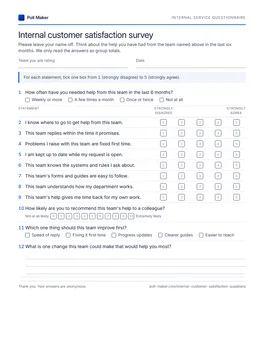
Internal service questionnaire
Sheet one holds Q1 to Q12 as pencil tick boxes, with a 0 to 10 row for the recommend question. The ticket survey and each team set follow.
Download PDF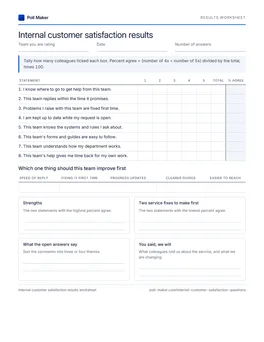
Team results worksheet
Tally the paper forms, turn the eight statements into percent agree, count the improve-first votes and note the two fixes you will make.
Download PDFWhat service teams ask before the first survey
Straight answers for IT, HR, finance and facilities leads.
What is an internal customer satisfaction survey?
A short survey that asks employees how well another team inside the company serves them. The people answering are the colleagues who use the service, and the questions cover reaching the team, speed, first-time fixes, updates, know-how and whether the help makes their own work easier.
How do you measure internal customer satisfaction?
Send the same core statements to everyone who used the team, then report percent agree for each statement and a 0 to 10 recommend score. Add a short survey after each closed ticket so you can see which kinds of request go wrong.
Can you use Net Promoter Score with internal customers?
Yes. Ask how likely people are to recommend the team's help to a colleague, then subtract the share of 0 to 6 answers from the share of 9 and 10 answers. It gives each support team one number to follow from round to round.
How often should you survey internal customers?
The short ticket survey after every closed request, the full review once or twice a year, and a five-question pulse each quarter in between if you want an early read.
How can a support team raise its scores quickly?
Start with the two lowest statements and the most common improve-first answer. Progress updates and clearer forms are often the quickest wins, because they need no new staff or systems. Then tell colleagues what changed.
See your service through your colleagues' eyes
Load Q1 to Q12 into the survey builder, attach the set for your kind of team, and send it to everyone who asked for help this year. Our <a href="/Satisfaction-Survey-Questions">satisfaction survey questions</a> cover customers outside the company too.