Supervisor feedback survey: rate your supervisor anonymously
Upward feedback lets the people who report to a supervisor rate what they see every week: clear instructions, a fair share of work, respect under pressure and help to get better. The core 13 takes about five minutes and asks for no names.
- 35questions
- 13in the core set
- 5 minto answer the core
- 6optional sets
By Michael Hodge, BSc Psychology Updated September 2026
All 35 supervisor feedback questions
Thirteen core questions start out selected and make a full upward feedback survey on their own. Six optional sets follow for one-to-ones, shift teams, workload, growth, a three-month recheck and demographics. Every supervisor question shows its rating scale or fixed choices, and a line explaining what a disappointing score would tell you about that person's habits.
The core 1313 questions
Nine statements about the supervisor's everyday habits, then a single overall score, the team's pick for next month's priority, and two write-in questions. These 13 already make a full upward feedback survey.
-
My supervisor gives instructions I can act on.
Strongly disagree12345Strongly agree1 = Strongly disagree, 5 = Strongly agreeClear direction, put as something an employee can test. Low scores usually trace back to rushed hand-overs at the start of a day or a week.
-
When I am stuck, I can reach my supervisor quickly.
Strongly disagree12345Strongly agree1 = Strongly disagree, 5 = Strongly agreeAvailability. A supervisor who is hard to reach turns small problems into lost hours, on the floor and in the office alike.
-
My supervisor tells me how I am doing between reviews.
Strongly disagree12345Strongly agree1 = Strongly disagree, 5 = Strongly agreeOngoing feedback. People who only hear at review time are surprised by the rating and stop trusting it.
-
My supervisor notices good work and says so.
Strongly disagree12345Strongly agree1 = Strongly disagree, 5 = Strongly agreeRecognition from the person closest to the work. A quick word counts here; this is not about awards or pay.
-
My supervisor shares out work fairly across the team.
Strongly disagree12345Strongly agree1 = Strongly disagree, 5 = Strongly agreeFair distribution of work. A low score points to favourites, or to a few reliable people carrying everyone else.
-
My supervisor stays respectful, even under pressure.
Strongly disagree12345Strongly agree1 = Strongly disagree, 5 = Strongly agreeRespect on a bad day is the real test. Federal employees gave respect from their supervisor one of the highest scores in their 2024 survey, so a low result here stands out.4
-
I can bring my supervisor bad news without worrying.
Strongly disagree12345Strongly agree1 = Strongly disagree, 5 = Strongly agreeWhether problems reach the supervisor early. If people sit on mistakes or delays, every other decision is made on partial information.
-
My supervisor acts on our concerns or explains why not.
Strongly disagree12345Strongly agree1 = Strongly disagree, 5 = Strongly agreeThe feedback loop. Employees accept a no that comes with a reason; silence is what makes them stop speaking up.
-
My supervisor helps me learn to do my job better.
Strongly disagree12345Strongly agree1 = Strongly disagree, 5 = Strongly agreeCoaching on the current job. The growth set goes further, into stretch work and next roles.
-
Overall, how would you rate your supervisor?
Very poorPoorFairGoodExcellentThe one-line answer to "rate your supervisor". Track it from round to round; the nine statements above explain the number.
-
Which would help you most from your supervisor next month?
Clear instructionsCheck-insRecognitionFair workloadCoachingThe team picks one priority. Each option points back to statement 1, 3, 4, 5 or 9, so the vote and the ratings can be read side by side.
-
What does your supervisor do that you want them to keep doing?
Open answerNames the habits worth protecting, so fixing one area does not cost the team something it values.
-
What is one thing your supervisor could start or stop doing that would help you most?
Open answerOne specific change per person. The answers tend to gather into two or three themes a supervisor can act on.
One-to-ones and feedback5 questions
Reach for this set when statement 3 is weak, or when people write about check-ins that get cancelled or turn into status updates.
-
How often do you get time alone with your supervisor to talk about your work?
Every weekEvery two weeksAbout once a monthA few times a yearHardly everFrequency before quality. Read the four statements below separately for people who hardly ever get this time.
-
I understand what to change when my work is corrected.
Strongly disagree12345Strongly agree1 = Strongly disagree, 5 = Strongly agreeFeedback people can use. A correction without a clear next step feels like criticism and rarely changes the work.
-
My supervisor asks me before changing how I do my job.
Strongly disagree12345Strongly agree1 = Strongly disagree, 5 = Strongly agreeConsultation on the changes employees notice most: the ones that land on their own tasks.
-
My supervisor stays open when someone disagrees.
Strongly disagree12345Strongly agree1 = Strongly disagree, 5 = Strongly agreeHow the supervisor takes pushback. It also signals whether people will be candid in the next round of upward feedback.
-
Our check-ins cover my questions, not just task updates.
Strongly disagree12345Strongly agree1 = Strongly disagree, 5 = Strongly agreeSeparates a real one-to-one from a task review. Both have a place, but only one is for the employee.
Shift work, schedules and safety5 questions
For supervisors of shift, hourly and frontline teams, where most of the relationship runs through the rota, the handover and the floor.
-
I get my schedule early enough to plan my life around it.
Strongly disagree12345Strongly agree1 = Strongly disagree, 5 = Strongly agreeNotice of hours sits largely in the supervisor's hands, and short notice spills into childcare, second jobs and study.
-
Busy, late and weekend shifts are shared out fairly.
Strongly disagree12345Strongly agree1 = Strongly disagree, 5 = Strongly agreeFairness where it is easiest to see. When the same person always works Saturdays, the whole team notices.
-
My supervisor makes sure I can take my breaks.
Strongly disagree12345Strongly agree1 = Strongly disagree, 5 = Strongly agreeA basic that slips on short-staffed days. Low scores usually mean cover is not planned in advance.
-
My supervisor acts quickly on safety risks I report.
Strongly disagree12345Strongly agree1 = Strongly disagree, 5 = Strongly agreeWhether safety reports lead anywhere. When they do not, people stop making them.
-
I start each shift knowing what I am meant to do.
Strongly disagree12345Strongly agree1 = Strongly disagree, 5 = Strongly agreeThe handover. A shift that opens with guesswork loses its first hour.
Workload and resources4 questions
For teams that describe being stretched. These separate a heavy month from a supervisor who is not clearing the way.
-
Most weeks, my workload is:
Too heavyHeavyAbout rightLightToo lightRead the spread, not an average. Too heavy and too light each call for a different conversation.
-
My supervisor clears obstacles that slow my work down.
Strongly disagree12345Strongly agree1 = Strongly disagree, 5 = Strongly agreeStuck approvals, missing parts, broken tools. Removing them is one of the most visible things a supervisor does for a team.
-
My supervisor pushes to fix staff or equipment shortages.
Strongly disagree12345Strongly agree1 = Strongly disagree, 5 = Strongly agreeAdvocacy upward. Employees judge a supervisor partly on how hard they fight for the basics the team needs.
-
When priorities clash, my supervisor says which comes first.
Strongly disagree12345Strongly agree1 = Strongly disagree, 5 = Strongly agreeA heavy week is easier to carry when someone ranks the work. Without that call, people guess and the loudest request wins.
Growth and credit3 questions
Add these when statement 9 is low, or in teams where people want to move up and are unsure the supervisor will help.
-
How long ago did your supervisor last talk with you about your goals or your future here?
Past month1 to 3 months3 to 6 months6+ monthsNeverA fact rather than an opinion, so it is easy to answer honestly and easy to compare between rounds.
-
My supervisor gives me work that stretches me.
Strongly disagree12345Strongly agree1 = Strongly disagree, 5 = Strongly agreeDevelopment through the work itself, not only through courses.
-
My supervisor would back me applying for a better role.
Strongly disagree12345Strongly agree1 = Strongly disagree, 5 = Strongly agreeShows whether the supervisor holds on to good people or helps them move up, even to another team. Teams notice which one it is.
Three months later3 questions
Send these with the core 13 about three months after the supervisor has talked the results through with the team. They show whether the loop closed.
-
Did your supervisor go over the last survey's results with the team?
Yes, as a teamYes, one to oneNoNot sureNew hereResearch on upward feedback ties this step to later improvement, so check that it happened.1
-
My supervisor acted on something we raised last survey.
Strongly disagree12345Strongly agree1 = Strongly disagree, 5 = Strongly agreeVisible change is what makes the next round worth answering.
-
I think honest answers to this survey lead to real changes.
Strongly disagree12345Strongly agree1 = Strongly disagree, 5 = Strongly agreeTrust in the process itself. A high score means the team sees the survey as worth their time, which keeps the answers candid.
About you (optional)2 questions
Only for supervisors with ten or more people answering. Leave this set out for smaller teams, where two answers can identify someone.
-
How long have you reported to this supervisor?
Under 6 months6 to 12 months1 to 3 yearsOver 3 yearsNewer team members judge on a short history. Compare them with longer-serving people before reading much into a gap.
-
Which best describes your work pattern?
Day shiftsLate shiftsRotatingOffice hoursRemoteNight, rotating and remote staff see less of the supervisor, so their answers can differ from the day team's.
Three conditions for honest upward feedback
Employees rate a supervisor honestly when three things are plain: nobody can trace their answers, the questions describe real behaviour, and something happens afterwards.

Make every answer untraceable
People soften ratings that carry their name. In a field experiment with 38 managers, employees who had to sign their upward appraisals rated their managers significantly higher than colleagues who answered anonymously, and said they were more comfortable answering anonymously.3 Ask for no names, switch off anything that records who responded, and show the supervisor combined results only. The team size table below covers the tricky case of a small team.
Federal employees who agreed with each statement about their supervisor, 2024
Set the scores against a large benchmark
Your own trend matters most, but a reference point helps the first time round. In the 2024 Federal Employee Viewpoint Survey, answered by more than 674,000 employees, 87% agreed that their supervisor treats them with respect and 83% that their supervisor listens to what they have to say. The survey's supervisor index, which covers trust, respect and support, reached 81%.4 Statement 6 asks about respect in different words, which makes a result in the high 80s a strong one.
Ask about the supervisor, because the team follows
Gallup estimates that managers account for at least 70% of the variance in employee engagement scores across business units, from an analysis of 11,781 work teams.5 That makes the person closest to the work the most useful one to ask about. Every statement in the core 13 describes something an employee has seen that supervisor do, or not do, in the last few weeks.
Keep it apart from pay and performance ratings
Upward feedback works as a development tool. West Virginia University runs its programme once a year, anonymously, and keeps it independent of performance management; its 12 questions take about five minutes.6 Put that promise in the invitation too, send the survey outside review season, and let the supervisor see the results before they are discussed with anyone above them.
Between survey rounds, a supervisor can put one question to the team on the spot. Put the next-month question to them as a quick team poll at the end of a shift briefing or huddle, then talk about the winning answer before anyone leaves. Running the huddle over video or chat? Our walkthrough for making a poll and sharing it handles video calls, links and chats.
See one supervisor's strengths and gaps on a page
Key in your team's answer counts, statement by statement, for the first nine questions. The chart then shows where the team agrees, marks the strongest and weakest statements, and prints as a one-page summary the supervisor can bring to the team meeting.
- 1The right-hand figure on each row is the share of raters who ticked 4 or 5 for that habit; the red figure on the left is the share who disagreed.
- 2Set the two statements tagged Focus beside the winning answer to question 11. If both name the same habit, start there.
- 3Read the keep-doing answers before the start-or-stop answers, so the meeting opens with what the team values.
- 4Use the overall rating in question 10 to follow one supervisor over time, never to rank supervisors against each other.
Supervisor feedback results
The 30-minute team meeting after the results
This is the step the research ties to better ratings the following year.1 The supervisor runs it, ideally within two weeks of receiving the report.

- Thank the team and say how many people answered. Never try to work out who wrote what, even to thank them.
- Share the two statements that came back strongest and one habit you will keep.
- Share the two weakest statements and whichever option won the vote in question 11. Say what you think they mean, then ask what a 5 would look like on this team.
- Listen more than you talk. Write the examples up where everyone can see them and argue with none of them.
- Commit to one or two changes, each with a date and a way the team will see it happen.
- Book the recheck: the core 13 plus the three-months-later set.
Smither and colleagues found that ratings were most likely to improve when the person rated believed change was possible, set goals and followed through.2 Step 5 is where that happens, so keep the list short enough to finish before the recheck.
Keeping answers anonymous when the team is small
A supervisor with four direct reports can often guess who wrote what, so anonymity has to be planned. Find the row that matches the number of people answering about one supervisor.
| People answering | What the supervisor sees | What to hold back |
|---|---|---|
| Fewer than 4 | Combined results with a peer supervisor's team, or themes passed on by HR in a conversation | Any per-statement numbers for that one supervisor |
| 4 to 9 | Per-statement agreement figures, the overall rating, and open answers retyped as themes by someone outside the team | The About you set, and any comment whose wording gives the writer away |
| 10 or more | Everything, including open answers, with splits by shift or tenure | Any split with fewer than 5 people in it |
West Virginia University's upward feedback programme leaves out open questions entirely "to ensure confidentiality and anonymity", and sends a supervisor a summary only once enough of their staff have answered.6 Paper works for small teams too: a locked box that someone outside the team empties, and a typed summary rather than the forms themselves.
A 90-day check for a newly promoted supervisor
Someone promoted from inside the team has to switch from peer to boss. Around day 60 to 90, these five show whether instructions, access, feedback and the flow of bad news survived the switch, and ask for one change to make next.
- 01My supervisor gives instructions I can act on.
- 02When I am stuck, I can reach my supervisor quickly.
- 03My supervisor tells me how I am doing between reviews.
- 04I can bring my supervisor bad news without worrying.
- 05What is one thing your supervisor could start or stop doing that would help you most?
Supervisor questions that get vague answers, and better versions
The weak versions ask employees to judge the person; the better ones ask about one thing they have watched happen. More fixes of this kind, sorted by question type, are in the survey question guide.
Is your supervisor a good leader?
My supervisor gives instructions I can act on.
My supervisor stays respectful, even under pressure.
A good leader means something different to everyone, so the answer ends up measuring how much people like the supervisor. Specific behaviours say what to repeat or change.
Does your supervisor communicate well and give regular feedback?
My supervisor tells me how I am doing between reviews.
Two topics share one question mark. An employee who gets plenty of team news but hears nothing about their own work cannot tick either end truthfully.
Rate your supervisor's management skills from 1 to 10.
My supervisor acts on our concerns or explains why not.
Management skill is an abstraction employees can only guess at. Acting on concerns is something every team member has watched happen, or not.
Your supervisor is never available when you need them. Agree or disagree?
When I am stuck, I can reach my supervisor quickly.
The weak version opens with a complaint and says never, which hardly anyone can agree with literally. The better one is neutral and still catches the problem.
A staff-room box for teams without work email
Paper suits teams without work email. Leave the forms out in a staff room for five working days beside a locked box that someone other than the supervisor empties.
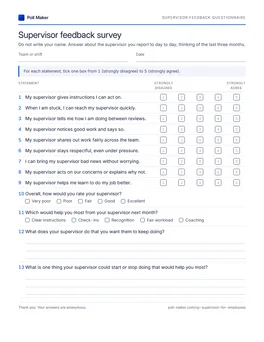
Supervisor feedback questionnaire
Page one: all 13 core questions, with boxes to tick and lines for the two write-in answers. One-to-ones, shifts, workload, growth, the recheck and About you follow.
Download PDF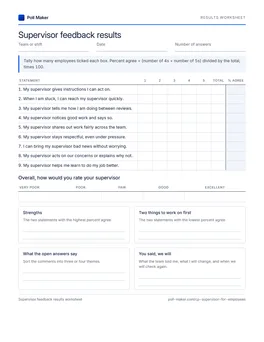
Supervisor results worksheet
Tally each of the nine statements by hand, work out how many agreed, and count the overall ratings from question 10.
Download PDFUpward feedback questions from HR and supervisors
Short answers for the first round.
What is upward feedback?
Upward feedback is when employees rate the person they report to, usually in an anonymous survey. It turns the usual review around: the supervisor learns how their everyday habits land with the team, then decides what to change.
Should a supervisor feedback survey be anonymous?
Yes. Named ratings come out higher: in a field experiment, employees who had to identify themselves rated their managers significantly higher than those who answered anonymously.3 Ask for no names, report combined results only, and follow the team size table above.
How often should employees rate their supervisor?
Give the full survey annually, or every six months for teams going through change, and send the recheck about three months after each team meeting. In the five-year study behind this page, the survey ran annually, and supervisors gained more in the years they talked the results over with their team.1
What is the difference between upward feedback and a 360 review?
Upward feedback comes only from the people who report to the supervisor. A 360 review adds the supervisor's own manager, peers and usually a self-rating. Upward feedback is shorter and covers the relationship that shapes a team's week; the leadership survey adds a self-rating set if you want to compare views.
How do I give feedback to my supervisor in person?
Pick one behaviour, describe when it happened and what it did to your work, and suggest what would help. The two open questions in the core, what to keep doing and what to start or stop, make a good script for that conversation too.
Can a supervisor send the survey to their own team?
Yes, as long as the link collects no names and the supervisor cannot see individual responses. For teams under ten, it is safer for HR or another supervisor to send it and pass on the combined report.
Start the first round of upward feedback
Open the core 13 in the builder, add the shift or one-to-one set if it fits the team, and pencil in the team meeting for the two weeks after the report arrives.