Customer loyalty survey questions to ask your rewards members
A customer loyalty program survey asks members two things your sales data cannot show: how you compare with the other places they shop, and whether the rewards change where they spend. Here are 38 questions with their answer choices, starting from a core 12 you can send with a receipt or inside your app.
- 38questions
- 12in the core
- 4 minfor the core
- 7optional sets
By Michael Hodge, BSc Psychology Updated September 2026
Every loyalty question, from the core set to non-members
The member core starts selected. Add a whole set from its heading, or pick questions singly. Each row lists the answer options a member sees, plus what a program manager can do with the result.
Every member: the core 1212 questions
Three questions place each member on the two axes of loyalty. Seven statements rate the program, and a likelihood-to-recommend score plus a single open question close it. On its own it makes a full member survey.
-
How often have you bought from us in the last three months?
Weekly or moreEvery 2 to 3 weeksAbout monthlyOnce or twiceNot at allHow often a member comes back, in their own words. If your till or order data already shows it, drop this one and keep the share question.
-
Of what you spend on things we sell, how much is with us?
All or nearly allMore than halfAbout halfLess than halfVery littleShare of spending, the behaviour half of loyalty. Your sales data cannot see what members buy elsewhere; this question can. A bank study used it as its behaviour measure.2
-
Compared with other places you could buy from, how do we rate?
Clearly the bestBetter than mostAbout the sameNot as goodFar behindThe attitude half. Loyalty is a preference over the alternatives, so a comparison says more than a rating of you alone. With the share question it places each member in the grid below.2
-
I know how to earn points or rewards.
Strongly disagree12345Strongly agree1 = Strongly disagree, 5 = Strongly agreeA program changes how people shop only when they know how it works. A low score is a signage and sign-up fix, the cheapest one here.
-
My next reward feels within reach.
Strongly disagree12345Strongly agree1 = Strongly disagree, 5 = Strongly agreeMembers buy more often as a reward gets close: in one cafe program the gap between coffees shrank on the way to a free one. A low score says shorten the path or give a head start.3
-
The rewards are things I actually want.
Strongly disagree12345Strongly agree1 = Strongly disagree, 5 = Strongly agreeReward fit. Low here while redeeming scores well points at the catalog, and the reward vote in the next set says what to add.
-
Redeeming a reward is easy.
Strongly disagree12345Strongly agree1 = Strongly disagree, 5 = Strongly agreePoints that are hard to spend feel like no points at all. Read it next to the unused points question.
-
The offers I get fit what I usually buy.
Strongly disagree12345Strongly agree1 = Strongly disagree, 5 = Strongly agreeOffer relevance. A low score often means every member gets the same email whatever they buy.
-
Being a member makes me choose you over other places.
Strongly disagree12345Strongly agree1 = Strongly disagree, 5 = Strongly agreeThe job the program is there to do. Compare the members who agree with those who do not on the share question.
-
Being a member makes me feel recognized here.
Strongly disagree12345Strongly agree1 = Strongly disagree, 5 = Strongly agreeRecognition, the part of a program that costs little: a birthday treat, early access, staff who notice the card.
-
How likely are you to recommend us to a friend or family member?
0123456789100 = Not at all likely, 10 = Extremely likelyYour recommend score: the share answering 9 or 10 minus the share answering 0 to 6. Bain reports that promoters, the 9s and 10s, account for more than 80% of referrals in most businesses.4
-
What one change would make our rewards program better for you?
Open answerAsking for one change gets concrete answers. Sort them into a few piles and read them beside the lowest statement.
Earning and redeeming6 questions
Add these when the core flags the rewards, the path to them or the payout, or before you change what members can earn.
-
Which reward would you most like to earn?
Money offFree productsFree deliveryEarly access to salesMembers-only eventsOne pick forces a priority. It also runs well as a one-question poll for members who never open a survey.
-
How do you feel about the time it takes to earn a reward?
Far too longA bit too longAbout rightQuicker than I expectedThe earning pace, the setting a program can change fastest. Read the spread, not an average.
-
How many rewards have you redeemed in the past year?
None yetOneTwo or threeFour or moreNot sureA member who has never redeemed has not felt the payoff yet. Compare their core answers with members who have.
-
If you have points you have not used, what is the main reason?
Not enough yetNo reward I wantI forgotRedeeming is a hassleSaving upNo unused pointsEach answer has its own fix: a smaller first reward, a better catalog, a reminder, a simpler checkout step, or nothing at all.
-
Points show up in my account soon after I buy.
Strongly disagree12345Strongly agree1 = Strongly disagree, 5 = Strongly agreeLate points feel like missing points and turn into calls and emails. A low score is a systems fix.
-
I can check my points balance whenever I like.
Strongly disagree12345Strongly agree1 = Strongly disagree, 5 = Strongly agreeMembers cannot feel close to a reward they cannot see. Pairs with the within-reach statement in the core.
Tiers, status and paid membership4 questions
For programs with member levels, or when you are weighing a paid tier.
-
Which member level are you on?
Entry levelA middle levelThe top levelNot sure"Not sure" is the finding. If many members do not know their level, the levels are not changing anything.
-
I know what it takes to reach the next level.
Strongly disagree12345Strongly agree1 = Strongly disagree, 5 = Strongly agreeA level only pulls members who can see it. The same idea as the next reward, one step up.
-
The perks of my level are worth what it takes to keep it.
Strongly disagree12345Strongly agree1 = Strongly disagree, 5 = Strongly agreeMembers at the top weigh the perks against their spending. Their low scores are the ones to act on first.
-
Would you pay a yearly fee for extra member perks?
YesMaybe, depending on the priceProbably notNoA first read on a paid tier. Test an actual price before you set one.
Card, app and checkout4 questions
For loyalty cards, key tags, stamp cards and app programs: the moment a member is recognized, or missed.
-
How do you usually show you are a member when you pay?
Card or key tagThe appPhone numberOnline accountI often forgetWhich way in members actually use. Every "I often forget" is lost points for them and lost data for you.
-
Getting my points at checkout is quick.
Strongly disagree12345Strongly agree1 = Strongly disagree, 5 = Strongly agreeThe one moment the program costs a member time. Staff and the till setup fix most of it.
-
The app or member account is easy to use.
Strongly disagree12345Strongly agree1 = Strongly disagree, 5 = Strongly agreeFor programs that live on a phone. Read it for members who picked the app above.
-
I trust you to keep my member details safe.
Strongly disagree12345Strongly agree1 = Strongly disagree, 5 = Strongly agreeMembers hand over details to take part. Trust decides how much they share and how accurate it is.
Member emails, texts and offers4 questions
Add these when you are planning the member calendar, or when offers stop bringing people in.
-
How often would you like to hear from us?
WeeklyEvery two weeksMonthlyOnly about my rewardsRarelyLets members set the pace, and shows whether today's schedule is too much or too little.
-
Where would you like to get member offers?
EmailText messageApp notificationAt the checkoutSocial mediaTick all that applyDrop the channels nobody picks and put the effort into the rest.
-
Member emails and texts are worth opening.
Strongly disagree12345Strongly agree1 = Strongly disagree, 5 = Strongly agreeWhat open rates cannot tell you: whether members think the messages are worth their time.
-
In the last month, did a member offer bring you in?
Yes, more than onceYes, onceSaw one, did not use itDid not see anyWhether offers change what members do. "Did not see any" is a reach problem, not an offer problem.
About you2 questions
Optional, and the last set for members. Keep only what you will sort the results by.
-
How old are you?
Under 2525 to 3435 to 4950 to 6465 or overOnly if you will act on it, for example if younger members want the app and older members the card.
-
How do you mostly shop with us?
In storeOnlineBoth about equallyStore and online members meet different parts of the program. Read their scores apart.
Customers who have not joined3 questions
For customers who pay without a member number. Hand it out at the checkout or put it on the receipt.
-
Did you know we have a rewards program before today?
YesNoNot sureIf most say no, the fix is at the checkout and on the door, not in the rewards.
-
What is the main reason you have not joined?
Did not know about itI do not shop here enoughToo many programs alreadyDo not want to share detailsThe rewards do not appealEach reason has a different fix: signage, a quicker first reward, a shorter form, or better rewards.
-
Which would most likely get you to join?
A welcome rewardPoints on today's purchaseSigning up in secondsNo marketing emailsNothing, thanksA head start works: cafe customers given two bonus stamps on a longer card finished it faster than customers with a plain card.3
Members who have gone quiet3 questions
For members with no purchase in six months or more. Send it with a welcome-back offer.
-
What is the main reason you shop with us less than before?
My routine changedBetter prices elsewhereRewards stopped being worth itA bad experienceI need it less nowSeparates what you can change from what you cannot. The middle three are yours to fix.
-
Do you now use another rewards program for the same things?
Yes, mostly that oneYes, I use bothNoTells you whether a rival program won the member, or something else did.
-
What would bring you back?
A welcome-back rewardBetter pricesDifferent productsBetter serviceNothing right nowTurns a lapsed list into a win-back offer members chose themselves.
Four kinds of loyalty, from two core questions
How members compare you with other places, and how much of their spending you get, sort every member into one of four groups. Each group needs a different next step.

| Group | How they answered | Next step |
|---|---|---|
| True loyalty | Rate you the best or better than most, and spend more than half with you | Thank them, give early access, ask for referrals |
| Latent loyalty | Rate you highly, but spend half or less with you | Find what sends the rest elsewhere: range, hours, location or price |
| Spurious loyalty | Spend most with you, but rate you level with or below others | Habit or convenience holds them; read their open answers first |
| No loyalty | Rate you level or lower, and spend half or less | Win-back offers only where the open answers show a fixable reason |
The grid comes from Dick and Basu, who described loyalty as the strength of the link between a customer's relative attitude and their repeat patronage.1 A study of 1,096 customers of a New Zealand bank measured the two axes with a recommend question scored 0 to 10 and share of banking business. The true loyals used the fewest banks, 1.43 on average against 2.37 for the no-loyalty group, and, level with the latent loyals, were the most likely to move more business to their main bank.2 So the recommend question in the core also works as the attitude axis: count 8 to 10 as high.
Put 240 member answers on the grid
Cross the comparison question with the share question, and every cell becomes a list with its own job.
Say 240 members answered the core:
| More than half their spending | Half or less | |
|---|---|---|
| Best or better than most | 96: true loyalty | 54: latent loyalty |
| About the same or lower | 42: spurious loyalty | 48: no loyalty |
The 54 latent loyals are the growth list: they already prefer you and still spend elsewhere, so their reward vote and one-change answers are the first to read. The 42 spurious loyals are the watch list: one better offer down the road could move them. The cut-offs are ours; keep them the same every time so the groups compare from one survey to the next.
When to ask, and who to ask beyond the program
Four habits that turn member answers into changes members notice.

Ask straight after a purchase
Print the link on the receipt, add it to the order email or show it on an app screen after checkout, while the visit is fresh. Pass the member number along with the answers, then drop anything your system already knows, such as how long someone has been a member or which level they are on. Each question you drop makes room for one only the member can answer.
Days to buy the ten coffees a reward card asked for
Give every member a head start
Progress pulls people toward a reward. In a field test at a university cafe, 108 customers got either a 10-stamp card or a 12-stamp card that came with two bonus stamps. Both needed ten more coffees, and the head-start group finished in 12.7 days against 15.6, nearly three days or 20% faster.3 The same study found members bought coffee more often the closer they got to a free one. If "My next reward feels within reach" scores low, add a welcome bonus or split one big reward into smaller steps.
Hear from customers outside the program
Members are half the story. Customers who never joined tell you what the sign-up asks of them, and members who have gone quiet tell you what you lost them to. Hand the not-joined set out when a customer pays without a member number, and send the gone-quiet set with a welcome-back offer so it arrives with a reason to return.
Thank members, then show what changed
A small, equal thank-you, such as the same points for every completed survey whatever the answers, rewards the time without tilting the results. Then report back in the next member email: what you heard, what changes, and from when. A member who spots their own suggestion in the program is the one who fills in next year's card.
Planning a new reward? Let members vote before you commit. Put the reward question up as a quick member poll on your website or in the next member email, and let the most popular pick lead. The poll making walkthrough covers adding one to a website and sending it by email.
Score the seven program statements
For each of the seven program statements, enter how many members ticked each box, 1 through 5. The chart ranks what the program does well and marks the two statements to fix next quarter. Print it for the marketing meeting.
- 1A statement's percent agree counts members choosing Agree or Strongly agree, divided by every member who answered that line. The panel does the sum.
- 2Read the within-reach, rewards and redeeming statements side by side. Together they show whether the problem is the path, the prize or the payout.
- 3Once each loyalty group has a few dozen answers, split the results by group. Latent loyals who score the rewards low are a growth signal worth acting on.
- 4Pull the one-change answers of members who marked the two weakest statements down; they tend to name the fix themselves.
- 5Tell members what will change in the next member email, with a date.
Member survey results
Match the survey to the member's moment
A rewards program has natural moments to ask. Send the right sets at each one and no member ever sees the whole bank.
| Moment | Who gets it | Sets to send |
|---|---|---|
| 30 days after joining | New members | Core, plus Card, app and checkout |
| After a first reward | Members who just redeemed | Core, plus Earning and redeeming |
| Once a year | Every active member | Core, plus Member emails, texts and offers, plus Tiers if you have them |
| Before you change rewards or levels | Active members | Earning and redeeming, plus Tiers, status and paid membership |
| At checkout, no member number | Customers who have not joined | The not-joined set, on a counter card or a receipt link |
| Six months with no purchase | Members who have gone quiet | The gone-quiet set, with a welcome-back offer |
Thinking about a paid tier? Test the fee first with willingness to pay questions. Selling a brand through other retailers rather than your own stores? Attitudes to the brand are a separate survey: SuperSurvey's brand loyalty questionnaire covers that job. For pricing, product and audience research beyond the program, browse the marketing survey question sets.
A pop-up short enough for the rewards app
A screen after checkout gets about a minute of attention. These five cover share of spending, how you compare, the distance to the next reward, redeeming and one change.
- 01Of what you spend on things we sell, how much is with us?
- 02Compared with other places you could buy from, how do we rate?
- 03My next reward feels within reach.
- 04Redeeming a reward is easy.
- 05What one change would make our rewards program better for you?
Cards members can fill in at the register
Some members never open an app. Keep a stack by the register, with pens and a sealed drop box. The files fit letter and A4 paper.
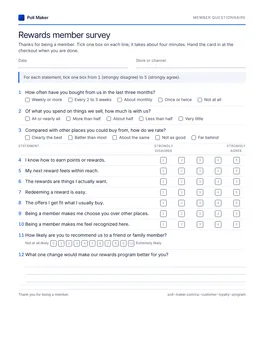
Member questionnaire
Sheet one carries the member core and a line for the store name. Rewards, tiers, card and offer sets come after it, so a store prints only the sheets its program uses.
Download PDF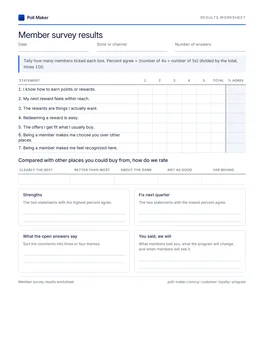
Quarterly results sheet
Count the cards by hand: percent agree for the seven program statements, a tally of how members compare you with other places, and next quarter's two fixes.
Download PDFWhere loyalty survey wording goes wrong
All four appear on real member surveys. Our question writing guide works through the same repairs for every question type.
How satisfied are you with our loyalty program?
My next reward feels within reach.
Redeeming a reward is easy.
One score for the whole program cannot say whether earning, the rewards or redeeming is the problem. Separate statements can.
Are you a loyal customer?
Of what you spend on things we sell, how much is with us?
Nearly everyone accepts a flattering label. A share question measures what members actually do.
Don't you love our new VIP perks?
The perks of my level are worth what it takes to keep it.
It signals the answer you are hoping for. Put neutrally, the statement lets let-down members say so.
Would you stay with us if a rival offered more points?
Compared with other places you could buy from, how do we rate?
A made-up offer gets a guess. A comparison with places the member already knows gets a real ranking.
Rewards program managers usually want to know
Short answers for shops, cafes, salons and online stores that run a rewards program.
What questions should a customer loyalty survey include?
Two that measure loyalty itself (how members compare you with other places, and how much of their spending you get), statements about earning, rewards, redeeming and offers, a likelihood to recommend score, and a single open question asking for one change. The member core above has all of these.
How do you measure customer loyalty with a survey?
Measure attitude and behaviour separately, then combine them. Ask how members rate you against the alternatives and what share of their spending you get, place each member in one of the four groups, and track how the groups move from one survey to the next alongside the recommend score.
Are customer loyalty and customer retention the same thing?
Not quite. Retention counts whether customers keep buying, which your sales data shows. Loyalty adds whether they prefer you to the alternatives, which only asking shows. A customer held by habit or convenience is retained, yet can still rate a rival higher.
How often should you survey loyalty program members?
Run the whole member core yearly, and short sets at the moments in the table above, such as a first reward or six quiet months. Keep any one member to a few surveys a year so each one still gets a careful answer.
Should members earn points for answering?
A small thank-you works well, as long as every member gets the same amount whatever they answer and you say so at the start. Rewarding only positive answers tilts the results.
Can I use these questions for a loyalty card or stamp card survey?
Yes. The card, app and checkout set covers plastic cards, key tags and apps, and the earning questions work the same for stamps as for points. Swap "points" for "stamps" in the builder before you send it.
Send it with your next receipt
Load the member core into the builder, bolt on whichever sets suit your rewards, then share the link on receipts, in the app or in the next member email. For the register, print the member card.