Ask IEP families about partnership, services and progress
A good special education parent survey asks families about things they see for themselves: whether they plan the IEP as equals, whether services happen as written, and whether they hear about progress before report cards. The core 12 takes parents about five minutes. Add a set for the last IEP meeting, parent input before the next one, or planning for life after school.
- 36questions
- 12in the core
- 5 minfor the core
- Pre-Kto age 21
By Michael Hodge, BSc Psychology Updated September 2026
All 36 special education parent survey questions
The core 12 comes pre-ticked. Add a whole set with its button, or tick questions one by one. Beside each question sit the answer options parents see and what a low or high result means for your special education team. Text your list to families, print it for backpacks, or paste the wording into a district system.
The core 1212 questions
Nine statements about partnership, services and progress, one question about how often school gets in touch, and two open questions. Send these alone for a yearly check with every IEP family.
-
I feel like a full member of my child's IEP team.
Strongly disagree12345Strongly agree1 = Strongly disagree, 5 = Strongly agreeThe partnership question. A low score here usually shows up again in the open answers.
-
My ideas actually change what goes into the IEP.
Strongly disagree12345Strongly agree1 = Strongly disagree, 5 = Strongly agreeBeing invited is not the same as being heard. This asks whether parent input moves the plan.
-
I understand each IEP goal and how it is measured.
Strongly disagree12345Strongly agree1 = Strongly disagree, 5 = Strongly agreeParents who cannot read the goals cannot track them. Low scores point to jargon in the plan itself.
-
Services happen as the IEP says, on schedule.
Strongly disagree12345Strongly agree1 = Strongly disagree, 5 = Strongly agreeService delivery, asked plainly. Missed speech or OT sessions surface here before they become complaints.
-
Accommodations are used in all my child's classes.
Strongly disagree12345Strongly agree1 = Strongly disagree, 5 = Strongly agreeChecks the general education classroom, where accommodations are most often forgotten.
-
Progress updates come often enough to catch problems.
Strongly disagree12345Strongly agree1 = Strongly disagree, 5 = Strongly agreeWhether news reaches home in time to act, not only at the annual review.
-
I know exactly who to ask about my child's services.
Strongly disagree12345Strongly agree1 = Strongly disagree, 5 = Strongly agreeA named contact person. When this scores low, families bounce between staff.
-
My child is included in the wider life of the school.
Strongly disagree12345Strongly agree1 = Strongly disagree, 5 = Strongly agreeClubs, trips, lunch and events. Inclusion outside the classroom is easy to miss in a service review.
-
My child has made real progress this school year.
Strongly disagree12345Strongly agree1 = Strongly disagree, 5 = Strongly agreeThe outcome question. Read it next to services and updates to see what drives it.
-
How often does school contact you about your child's progress?
WeeklyMonthlyEach termRarelyPuts a number on the updates statement, so you can see which contact rhythm families rate well.
-
What is one thing the school does that really helps your child?
Open answerTells staff what to protect when schedules or caseloads change.
-
What one change would make the biggest difference for your child?
Open answerOne change, so parents pick their priority. The answers group into a few themes quickly.
The last IEP meeting6 questions
Send these within a week of an annual review or IEP meeting, while the details are fresh.
-
I got draft papers early enough to read them first.
Strongly disagree12345Strongly agree1 = Strongly disagree, 5 = Strongly agreeParents who see drafts ahead come ready to discuss, not only to listen.
-
The meeting time worked for my family.
Strongly disagree12345Strongly agree1 = Strongly disagree, 5 = Strongly agreeA simple fix when it scores low: offer early, late or phone options.
-
Staff explained test results in plain language.
Strongly disagree12345Strongly agree1 = Strongly disagree, 5 = Strongly agreeEvaluation scores are the hardest part of most meetings to follow.
-
There was enough time for all my questions.
Strongly disagree12345Strongly agree1 = Strongly disagree, 5 = Strongly agreeRushed meetings leave parents signing a plan they have not fully discussed.
-
How many of the things you raised made it into the IEP?
AllMostSomeFew or noneI raised nothingA concrete count of whether parent concerns reached the written plan.
-
What would have made the meeting easier for you?
Open answerSurfaces practical fixes: an interpreter, a shorter agenda, a call beforehand.
Before the next IEP meeting (parent input)6 questions
Send these two weeks before a meeting, so the team reads the family's view before anyone writes a goal.
-
What are your child's biggest strengths right now?
Open answerGoals built on strengths start from what already works.
-
What has changed for your child at home since the last IEP?
Open answerNew diagnoses, medication, sleep or family changes the school may not know about.
-
What worries you most about school this year?
Open answerPuts the parent's top concern on the agenda before the meeting starts.
-
What would you love your child to be able to do a year from now?
Open answerA parent's own goal, in their words, to set beside the team's draft goals.
-
Which areas do you want to talk about at the meeting?
ReadingWritingMathSpeechBehaviorFriendshipsIndependenceHealthTick all that applyLets the team bring the right staff and data to the table.
-
What works at home that school could try?
Open answerRoutines, rewards and calming strategies that already work for this child.
Communication and disagreements4 questions
Worth adding once families start writing about phone tag, missing letters or a decision a family did not agree with.
-
How do you prefer to hear from school?
TextEmailPhone callSchool appPaper noteSend updates where families will actually read them.
-
Letters and reports come in the language I read best.
Strongly disagree12345Strongly agree1 = Strongly disagree, 5 = Strongly agreeLanguage access, asked of every family rather than assumed.
-
When I disagree, staff listen and work it through with me.
Strongly disagree12345Strongly agree1 = Strongly disagree, 5 = Strongly agreeShows whether disagreements get solved at the table or escalate.
-
I know my rights if I disagree with a school decision.
Strongly disagree12345Strongly agree1 = Strongly disagree, 5 = Strongly agreeParents who know their options can raise problems early and calmly.
Planning for life after school (teens)4 questions
For families of teens whose IEP now plans for work, study and living after high school.
-
The plan for after high school reflects what my child wants.
Strongly disagree12345Strongly agree1 = Strongly disagree, 5 = Strongly agreeTransition goals should come from the student, not only the staff.
-
School has talked with us about jobs, college or training.
Strongly disagree12345Strongly agree1 = Strongly disagree, 5 = Strongly agreeChecks that the conversation about adult life has actually started.
-
I know which adult services to contact before graduation.
Strongly disagree12345Strongly agree1 = Strongly disagree, 5 = Strongly agreeFamilies often find out about waitlists too late. This flags it early.
-
What is your child's main goal after high school?
CollegeJob trainingWorkSupported livingNot sure yetLets you compare the team's plan with the family's hopes.
About your child (optional)4 questions
Ask these when you plan to split results by grade, setting or language. Special education groups are small, so merge any group under ten families before you report it.
-
What grade is your child in?
PreschoolK to 56 to 89 to 12Age 18 to 21Shows whether families at one level have a different experience.
-
How much of the day is your child in general classes?
Most of the dayAbout halfLess than halfSeparate classInclusion and accommodation scores often differ by setting.
-
How long has your child had an IEP?
Under 1 year1 to 3 years4 years or moreNew families often need more explanation than experienced ones.
-
What language do you speak most at home?
EnglishSpanishAnother languageTells you whether translated letters and interpreters are reaching the families who need them.
Who sends which version
The same families get asked by different people for different reasons. Match the sets to the job so nobody gets three long surveys in one term.
| Who runs it | Sets to send | When |
|---|---|---|
| District special education office | Core 12, Communication, About your child | Once a year, in spring |
| Parent advisory council (SEPAC) | Core 12 and Communication | Before the council sets its goals for the year |
| Case manager | Parent input | Two weeks before each IEP meeting |
| School team | The last IEP meeting | Within a week of the meeting |
| Transition coordinator | Core 12 and Life after school | Each fall, for teens with a transition plan |
Keep the core 12 identical from year to year, so this spring's numbers line up with last spring's. For a wider school climate survey that every parent answers, see the education survey questions collection.
Why busy families answer some surveys and not others
Special education families are busy, often surveyed, and quick to notice a survey that goes nowhere. Four habits change that.
Share of special education parents who agreed, by statement
Ask about the weeks between meetings
Families usually rate the people and the meetings well. In Washington's 2022-23 parent survey, 88% agreed teachers were available to speak with them and 84% felt treated as a team member. The weaker areas were what happens between meetings: 70% agreed they heard regularly about progress on IEP goals, 60% that the school explained their options when they disagreed, and 47% that the school offered parent training.1 So the core 12 spends its statements on updates, services on schedule and a named contact, not only on the meeting.

Reach every family two ways
Washington's statewide round heard from 2,443 families, 14.2% of those invited.1 Oregon texts a secure survey link in April and then mails a letter and a paper copy in May to families who have not answered.5 A school starts with an advantage: it has every family's number and a meeting on the calendar with each one. Text the link, send paper home, offer translated copies, and hand a copy over at the end of every IEP meeting in spring.

Check each IEP meeting while it is fresh
The annual survey tells you about the year. The meeting set, sent within a week, tells the team how each meeting felt: drafts in time, plain explanations, enough time for questions, and how many of the parent's points reached the plan. Case managers see the pattern after a handful of meetings.

Protect families in small programs
A program with six students in one class cannot report that class on its own without families being recognised. Combine small groups before you share results, never report a group under ten, and leave the child's name, disability and teacher off the form. Families who trust that, write more in the open answers. It matters: in a national survey of 965 mothers of students with disabilities, those with good or excellent relationships with the school reported lower stress.3
At a parent council meeting or a family night, one question on the screen gets the room talking. Project a live poll for parents, let everyone vote from their seat, and talk through the result together. The steps to share one by link or code are in how to make a poll.
Turn parent answers into next year's priorities
Enter how many parents picked each point on the nine core statements. The report works out the share who agree, marks the strongest and weakest, and prints a single sheet your team can hand to the parent advisory council.
- 1Treat a 4 or a 5 as agreement. A share agreeing is easier to explain at a parent meeting than an average score.
- 2Look at services, updates and a named contact together. When all three are low, the fix is usually a case manager who calls home monthly.
- 3Split by the contact question. If families contacted weekly or monthly score far higher, you have your case for a contact routine.
- 4Share two findings and two changes with families before the next survey, in the same channels you used to send it.
Core 12 results
Parent input before an IEP meeting
Many searches for a special education parent questionnaire are really looking for this: a form families fill in before the meeting, so their view is on paper when the team sits down.
Federal rules require it to count. In developing each IEP, the team must consider "the concerns of the parents for enhancing the education of their child."4 The six input questions give those concerns a place to land before the draft is written.
Send it early
Two weeks ahead gives parents a weekend to think and the case manager time to read the answers. Send the link by text with a paper copy in the backpack, and offer to take answers over the phone.
Bring the answers to the table
Print each family's answers and put them at the top of the meeting packet. Open the meeting with the strengths answer, then turn the parent's one-year hope into a draft goal the team can shape together.
Close the loop in the next survey
A week after the meeting, the IEP meeting set asks how many of the parent's points made it into the plan. Run both and you can see whether input is being used, not only collected.
Take-home folders, the front office and spring IEP meetings
Paper still reaches families who never open a school email. Send it home in folders, keep a stack at the front office, and hand one over at each spring IEP meeting.
Write a return date on the folder so forms come back before the spring meetings.
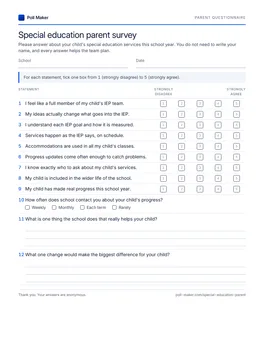
Parent questionnaire
A parent can finish the first sheet, the core 12, at the kitchen table in five minutes. The meeting, parent input, communication and life-after-school sets follow, with About your child last.
Download PDF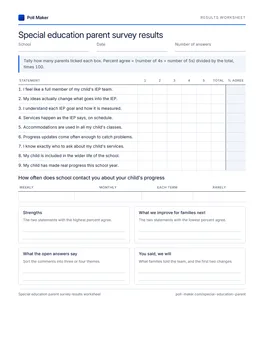
Team results worksheet
A one-sheet tally for the nine core statements and the contact question, with space to write each share agreeing and the two areas your team tackles first.
Download PDFHow this relates to your state's Indicator 8 survey
Every state reports to the U.S. Department of Education on the share of special education parents who say schools helped them take part in their child's education. That is IDEA Part B Indicator 8, and it is why families get a state parent survey.
Washington, for one, uses the NCSEAM parent involvement scale for it, scores each family from 0 to 1000 and counts a family as positive at 600 or above. In Washington's 2022-23 round, 28.2% of responding parents reached that standard.1 States choose different items and cut points, and Elbaum found those choices alone could move a state's reported percentage by as much as 40 percentage points.2
So use the state survey for what it is: an accountability measure. This page gives your school or district its own survey, in original wording, that you can run any month and repeat. It covers the same ground as the state instruments, partnership, information and rights, and adds what they leave out:
- whether services happen as the IEP says (c4)
- accommodations in general education classes (c5)
- inclusion in the wider life of the school (c8)
- whether parents see real progress (c9)
Compare your results with your own last round, not with a state percentage built on a different method. This page is not affiliated with NCSEAM or any state agency.
Mid-year and short: five questions after report cards
Short on time, or asking families mid-year? These five cover partnership, services, updates and a named contact, plus the one change parents would make.
- 01I feel like a full member of my child's IEP team.
- 02Services happen as the IEP says, on schedule.
- 03Progress updates come often enough to catch problems.
- 04I know exactly who to ask about my child's services.
- 05What one change would make the biggest difference for your child?
School survey questions parents struggle with
Four questions that often appear on school surveys and why parents struggle with them. The survey questions guide covers fixes for every question type.
Are you satisfied with special education services?
Services happen as the IEP says, on schedule.
Satisfaction mixes the child, the staff and the paperwork into one number. The better version names a thing the team controls.
Do you understand your child's IEP and your procedural safeguards?
I understand each IEP goal and how it is measured.
I know my rights if I disagree with a school decision.
Two questions in one, and a legal term many parents have never heard. Split it and use plain words.
How well does the school implement LRE for your child?
Accommodations are used in all my child's classes.
My child is included in the wider life of the school.
Acronyms shut parents out. Ask about what they can see: supports in class and a place in school life.
Don't you agree the IEP team values parent input?
My ideas actually change what goes into the IEP.
The weak version leads parents to agree. The better one asks for evidence they can judge.
From directors, case managers and parent councils
For special education directors, case managers and parent councils planning a survey.
What is the special education parent survey from the state?
Each state surveys families of students with IEPs to report IDEA Part B Indicator 8: the share of parents who say schools helped them take part in their child's education. It is an accountability measure. A district or school can also send its own, such as the set on this page, and use the answers to decide what to fix first.
Should a special education parent survey be anonymous?
Yes, for the yearly survey. Leave off names, disability and teacher, and combine small classes before reporting. The parent input set is the exception: the case manager needs to know whose answers they are reading.
What should parents fill out before an IEP meeting?
A short input form: the child's strengths, changes at home, the biggest worry, a one-year hope, topics to discuss and what works at home. The parent input set asks exactly those six things.
How can we get more parents to respond?
Use two channels: a texted link and a paper copy home. Offer translations and hand the survey over at spring IEP meetings. Tell families what changed after the last survey; that is the strongest reason to answer the next one.
Can I use this survey for students with 504 plans?
Yes. After you load the set into the builder, swap "IEP" for "504 plan" wherever it appears. Skip the transition set, and keep the meeting and input sets for 504 meetings.
Hear from every IEP family this year
Text families a link to the core 12 tonight, or print the parent questionnaire for take-home folders and spring IEP meetings.